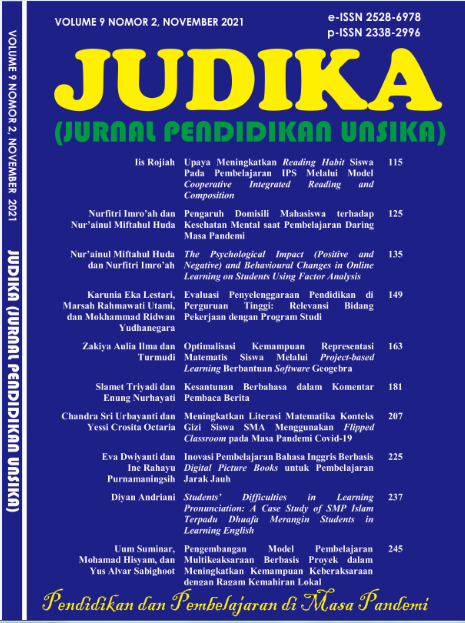
OPTIMALISASI KEMAMPUAN REPRESENTASI MATEMATIS SISWA MELALUI PROJECT-BASED LEARNING BERBANTUAN SOFTWARE GEOGEBRA
DOI:
https://doi.org/10.35706/judika.v9i2.5496Abstract
This study has the following objectives: 1) measuring the increase in students' mathematical abilities who learn through Project-based Learning assisted by Geogebra software compared to students who learn through ordinary learning; 2) measuring the achievement of students' mathematical representation abilities who learn through Project-based Learning assisted by Geogebra software compared to students who learn through ordinary learning; 3) measuring the average achievement of students' mathematical representation abilities who learn through Project-based Learning assisted by Geogebra software compared to the Minimum Completeness Criteria (KKM) for mathematics of 75. This study is a quasi-experimental study with a non-equivalent control group design, which was conducted on students class XI at SMA Negeri 1 Telukjambe Timur with the subject Integral. The results of the study show that: 1) the increase in students' mathematical representation abilities who learn through Project-based Learning assisted by Geogebra software is better than students who learn through ordinary learning. 2) the achievement of mathematical representation abilities of students who learn through Project-based Learning assisted by Geogebra software is better than students who learn through ordinary learning. 3) the average achievement of students' mathematical representation abilities who learn through Project-based Learning assisted by Geogebra software reaches KKM 75.
Keywords:
Project-based Learning; Geogebra Software; Students' Mathematical Representation Ability.
Downloads
Downloads
Published
Issue
Section
Citation Check
License
Copyright (c) 2021 JUDIKA (JURNAL PENDIDIKAN UNSIKA)

This work is licensed under a Creative Commons Attribution-ShareAlike 4.0 International License.
The copyright of this article is held by the JUDIKA (JURNAL PENDIDIKAN UNSIKA). All rights are reserved. No part of this article may be reproduced, distributed, or transmitted in any form or by any means without prior written permission from the JUDIKA Journal, except as permitted under applicable copyright laws.