Developing Student Worksheet of Cylinder Using Techno-Ethno-Realistic Mathematics Education Assisted by Augmented Reality
DOI:
https://doi.org/10.35706/sjme.v10i1.13306Keywords:
Cylinder, Augmented Reality, Students Activity Sheet, Ethnomathematics, RMEAbstract
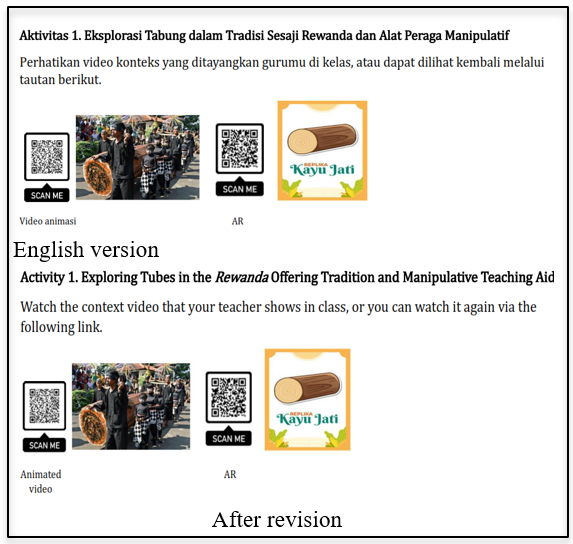
Mastery of cylinder material is essential for strengthening students’ spatial reasoning and understanding of curved-3D shapes; however, prior research shows persistent difficulties in learning 3D shapes one of them is thc cylinder. These difficulties are often exacerbated by limited use of innovative, contextual, and technology-supported learning materials. To address these challenges, this research integrates three key components ethnomathematics, RME, and technology to support dynamic visualization of cylindrical shapes. This study aims to develop a student worksheet using the Techno-Ethno-Realistic Mathematics Education (TE-RME) approach assisted by AR for learning cylinder concepts in junior secondary school. This study uses a design research methodology in two stages, namely a preliminary study and formative evaluation. The subjects of this study were 33 ninth-grade students of junior high school in Semarang. Data collected through observations, tests, and interviews were analyzed descriptively. This study produced a student activity sheet on cylinder material, which was combined with animated video and AR media whose effectiveness and efficiency align with the characteristics of the TE-RME approach. Based on these findings, it can be concluded that the TE-RME-based student activity sheet combined with animated video and AR media is efficient and effective in helping students develop conceptual understanding and problem-solving skills. The integration of animated video and AR media and the TE-RME approach reflects a commitment to innovation and continuous development of effective learning designs that promote inclusive, equitable, and meaningful learning experiences.
Downloads
References
Arifin, S., Zulkardi, Z., Putri, R. I. I., & Hartono, Y. (2021). On creativity through mathematization in solving non-routine problems. Journal on Mathematics Education, 12(2), 313–330. https://doi.org/10.22342/jme.12.2.13885.313-330
Çakiroğlu, Ü., & Şahın, Ö. İ. (2026). Building blocks of abstraction: Exploring children’s real-life problem solving in block-based programming. Thinking Skills and Creativity, 59, 101995. https://doi.org/10.1016/j.tsc.2025.101995
Cherif, A. H., Blvd, W. J., Gialamas, S., & Stamati, A. (2017). Developing mathematical knowledge and skills through the awareness approach of teaching and learning. Journal of Education and Practice. 8(13), 108-132.
Erita, S., Utami, E. S. D., & Ningsih, F. (2022). Realistic mathematics education-based student worksheet to improve students’ mathematical reasoning on circle material. Indonesian Journal of Science and Mathematics Education, 5(2), 210–223. https://doi.org/10.24042/ijsme.v5i2.11249
Gargrish, S., Mantri, A., & Kaur, D. P. (2020). Augmented reality-based learning environment to enhance teaching-learning experience in geometry education. Procedia Computer Science, 172, 1039–1046. https://doi.org/10.1016/j.procs.2020.05.152
Hardiyanto, D., Asokawati, I., Majid, P. M., Maesaroh, A. T., & Nursyahidah, F. (2024). Learning reflection using realistic mathematics education assisted by GeoGebra software. Jurnal Pendidikan Matematika, 18(1).
Jannah, H. I., & Amir, M. F. (2025). Hypothetical learning trajectory on cylinder with Bloom’s taxonomy perspective. Journal of Honai Math, 8(1), 89–114. https://doi.org/10.30862/jhm.v8i1.848
Koparan, T., Dinar, H., Koparan, E. T., & Haldan, Z. S. (2023). Integrating augmented reality into mathematics teaching and learning and examining its effectiveness. Thinking Skills and Creativity, 47, 101245. https://doi.org/10.1016/j.tsc.2023.101245
Kusuma, A. P., Aslamia, A. S., Sintiya, H., Rahayu, R. G., & Rahmawati, N. K. (2023). Analysis of students’ difficulties in solving problems related to solid geometry. Brillo Journal, 2(2), 108–121. https://doi.org/10.56773/bj.v2i2.37
Nursyahidah, F. (2021). Learning design on surface area and volume of cylinder using Indonesian ethno-mathematics of traditional cookie maker assisted by GeoGebra. In Mathematics Teaching-Research Journal. 13(4), 79–98.
Nursyahidah, F., Albab, I. U., & Mulyaningrum, E. R. (2023). Learning design of quadrilateral STEM-based through lesson study. Eurasia Journal of Mathematics, Science and Technology Education, 19(11), em2352. https://doi.org/10.29333/ejmste/13747
Nursyahidah, F., Albab, I. U., & Rubowo, M. R. (2023). Learning design of sphere using realistic mathematics education assisted by interactive video. Mathematics Education Journal, 17(3).
Nursyahidah, F., Wardono, Mariani, S., & Wijayanti, K. (2025a). Integrating technology, Javanese ethnomathematics, and realistic mathematics education in supporting prospective mathematics teachers’ numeracy skills: A learning trajectory. Journal on Mathematics Education, 16(2), 671–688. https://doi.org/10.22342/jme.v16i2.pp671-688
Nursyahidah, F., Wardono, W., Mariani, S., & Wijayanti, K. (2025b). Integrating technology, ethnomathematics, and realistic mathematics education in learning statistics: A learning trajectory. Infinity Journal, 14(3), 633–654. https://doi.org/10.22460/infinity.v14i3.p633-654
Pujiastuti, H., & Haryadi, R. (2024). The effectiveness of using augmented reality on the geometry thinking ability of junior high school students. Procedia Computer Science, 234, 1738–1745. https://doi.org/10.1016/j.procs.2024.03.180
Ruipérez-Valiente, J. A., & Kim, Y. J. (2020). Effects of solo vs. collaborative play in a digital learning game on geometry: Results from a K12 experiment. Computers & Education, 159, 104008. https://doi.org/10.1016/j.compedu.2020.104008
Sudirman, Runisah, Kusumah, Y. S., & Martadiputra, B. A. P. (2023). Epistemological obstacle in 3D geometry thinking: Representation, spatial structuring, and measurement. Pegem Journal of Education and Instruction, 13(4). https://doi.org/10.47750/pegegog.13.04.34
Tessmer M. (1993). Planning and Conducting Formative Evaluation. In London, Philadelphia:Kogan Page. https://doi.org/10.4324/9780203061978
Winarni, S., Siregar, A. S. W., Marlina, M., Rohati, R., & Kumalasari, A. (2023). Design and validation of augmented reality-based student worksheets for polyhedra material in improving students’ spatial abilities: Indonesian Journal of Mathematics Education, 6(2), 111–121. https://doi.org/10.31002/ijome.v6i2.845
Yaniawati, P., Sudirman, S., Mellawaty, M., Indrawan, R., & Mubarika, M. P. (2023). The potential of mobile augmented reality as a didactic and pedagogical source in learning geometry 3D. Journal of Technology and Science Education, 13(1), 4. https://doi.org/10.3926/jotse.1661
Zou, N., Wang, R., Chai, C., & Zhang, X. (2025). Spatial adventure: An augmented reality system for children’s spatial skills training. International Journal of Child-Computer Interaction, 46, 100783. https://doi.org/10.1016/j.ijcci.2025.100783
Zulkardi, & Setiawan, M. B. T. (2020). Javanese calendar as context to learn number pattern and least common multiple. Journal of Physics: Conference Series, 1470(1), 012094. https://doi.org/10.1088/1742-6596/1470/1/012094
Zulkardi, Z., & Putri, R. I. I. (2020). Supporting mathematics teachers to develop jumping task using PISA framework (JUMPISA). Jurnal Pendidikan Matematika, 14(2), 199–210. https://doi.org/10.22342/jpm.14.2.12115.199-210
Downloads
Published
How to Cite
Issue
Section
Citation Check
License
Copyright (c) 2026 Farida Nursyahidah, Irkham Ulil Albab, Maya Rini Rubowo

This work is licensed under a Creative Commons Attribution-ShareAlike 4.0 International License.
Authors who publish with this journal agree to the following terms:
- Authors retain copyright and grant the journal right of first publication with the work simultaneously licensed under a Creative Commons Attribution License that allows others to share the work with an acknowledgment of the work's authorship and initial publication in this journal.
- Authors are able to enter into separate, additional contractual arrangements for the non-exclusive distribution of the journal's published version of the work (e.g., post it to an institutional repository or publish it in a book), with an acknowledgment of its initial publication in this journal.
- Authors are permitted and encouraged to post their work online (e.g., in institutional repositories or on their website) prior to and during the submission process, as it can lead to productive exchanges, as well as earlier and greater citation of published work (See The Effect of Open Access).