Evaluating the Golden Ratio Claim in Water Spinach Internode Distances: An Inquiry-STEM Activity Design for Ratio Learning
DOI:
https://doi.org/10.35706/sjme.v10i2.13601Abstract
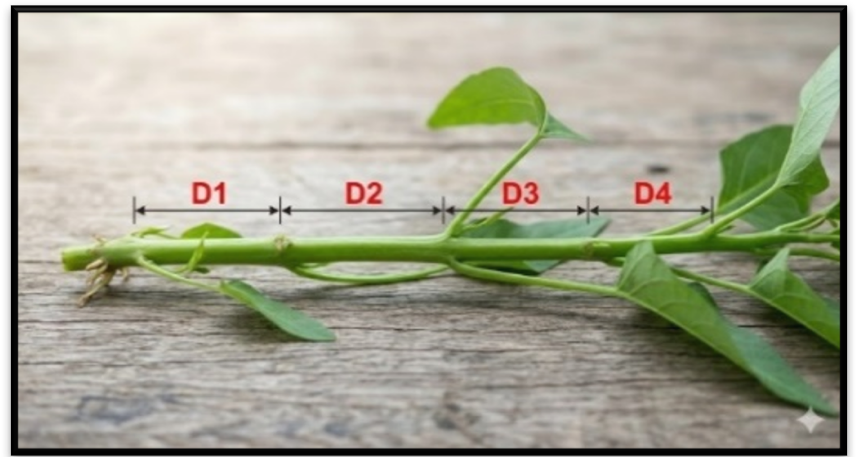
The claim that the golden ratio appears in nature is frequently used as a context for mathematics learning; however, such claims require rigorous examination through precise variable definitions and appropriate analysis. This study critically examined whether internode-distance patterns in water spinach (Ipomoea aquatica) approximate the golden ratio. The objectives were to: (1) describe the pattern of five consecutive internode distances across 30 water spinach stems, (2) examine the closeness of adjacent-distance ratios to φ = 1.618, and (3) translate the findings into an inquiry-STEM activity for ratio learning. The data comprised 150 distance measurements and 120 adjacent paired ratios collected using AR Meter, a smartphone-based augmented reality measurement application. The analysis retained directional ratios to identify positional changes and used symmetric ratios, defined as the longer distance divided by the shorter distance, to evaluate proximity to φ. Differences among the five positions were tested using the Friedman test, while stem-level geometric means were compared with φ using the Wilcoxon signed-rank test. The results showed significant differences in internode distance by position, χ²(4) = 22.744, p < 0.001, Kendall’s W = 0.190. The arithmetic mean of the 120 symmetric ratios was 1.629, which appeared close to φ but was influenced by two extreme ratios, 11.25 and 11.67. Only 11 of the 120 ratios (9.17%) fell within a 5% tolerance of φ. Therefore, the data did not support a consistent golden-ratio pattern in water spinach internode distances. The educational value of this study lies in using an unconfirmed popular claim as a context for teaching measurement, reciprocal ratios, robust statistics, and evidence-based argumentation through inquiry-STEM.
Downloads
References
Apriastuti, N. P. E., Putra, A. A. G., & Karnata, I. N. (2023). Respon pertumbuhan tanaman kangkung darat (Ipomoea reptans Poir.) terhadap dosis pupuk urea. 01(01), 45–49. https://doi.org/10.58878/jissiwirabuda.v1i1.186 [accessed July 1, 2026].
Ben-Chaim, D., Keret, Y., & Ilany, B. S. (2012). Ratio and proportion: Research and teaching in mathematics teachers’ education. Sense Publishers. https://doi.org/10.1007/978-94-6091-784-4 [accessed June 20, 2026].
Bergeron, F., & Reutenauer, C. (2019). Golden ratio and phyllotaxis, a clear mathematical link. Journal of Mathematical Biology, 78(1–2), 1–19. https://doi.org/10.1007/s00285-018-1265-3 [accessed June 20, 2026].
Campbell, S., Greenwood, M., Prior, S., Shearer, T., Walkem, K., Young, S., Bywaters, D., & Walker, K. (2020). Purposive sampling: Complex or simple? Research case examples. Journal of Research in Nursing, 25(8), 652–661. https://doi.org/10.1177/1744987120927206
Cao, X., Lu, H., Wu, Q., & Hsu, Y. (2025). Systematic review and meta-analysis of the impact of STEM education on students’ learning outcomes. Frontiers in Psychology, 1579474(August), 1–15. https://doi.org/10.3389/fpsyg.2025.1579474 [accessed June 20, 2026].
Faizah, S., Rahmawati, N. D., & Murniasih, T. R. (2021). Investigasi struktur argumen mahasiswa dalam pembuktian aljabar berdasarkan skema Toulmin. AKSIOMA: Jurnal Program Studi Pendidikan Matematika, 10(3), 1466–1476. https://doi.org/10.24127/ajpm.v10i3.3781 [accessed July 2, 2026].
Godin, C., Gole, C., & Douady, S. (2020). Phyllotaxis as geometric canalization during plant development. Development. https://doi.org/10.17226/13165 [accessed June 20, 2026].
Hasler, O., Blaser, S., & Nebiker, S. (2020). Performance evaluation of a mobile mapping application using smartphones and augmented reality frameworks. ISPRS Annals of the Photogrammetry, Remote Sensing and Spatial Information Sciences, V-2-2020, 741–747. https://doi.org/10.5194/isprs-annals-V-2-2020-741-2020 Hollander, M., Wolfe, D. A., & Chicken, E. (2014). Nonparametric statistical methods (3rd ed.). John Wiley & Sons.
Holm, S. (1979). A simple sequentially rejective multiple test procedure. Scandinavian Journal of Statistics, 6(2), 65–70. https://doi.org/10.2307/4615733
Limpert, E., Stahel, W. A., & Abbt, M. (2001). Log-normal distributions across the sciences: Keys and clues. BioScience, 51(5), 341–352. https://doi.org/10.1641/0006-3568(2001)051[0341:LNDATS]2.0.CO;2
National Research Council. (2012). A framework for K-12 science education: Practices, crosscutting concepts, and core ideas. The National Academies Press. https://doi.org/10.17226/13165 [accessed June 20, 2026].
OECD. (2022). PISA 2022 results (Volume I): The state of learning and equity in education: Vol. I. OECD Publishing. https://doi.org/10.1787/53f23881-en [accessed June 20, 2026].
Okabe, T. (2015). Biophysical optimality of the golden angle in phyllotaxis. Scientific Reports, 3–5. https://doi.org/10.1038/srep15358 [accessed June 20, 2026].
Okabe, T., Ishida, A., & Yoshimura, J. (2019). The unified rule of phyllotaxis explaining both spiral and non-spiral arrangements. Journal of the Royal Society Interface, 16(151), Article 20180850. https://doi.org/10.1098/rsif.2018.0850 [accessed June 20, 2026].
Prahmana, R. C. I., Sagita, L., Hidayat, W., & Utami, N. W. (2020). Two decades of realistic mathematics education research in Indonesia: A survey. Infinity Journal, 9(2), 223–246. https://doi.org/10.22460/infinity.v9i2.p223–246 [accessed June 20, 2026].
Revina, S., & Leung, F. K. S. (2019). How the same flowers grow in different soils? The implementation of realistic mathematics education in Utrecht and Jakarta classrooms. International Journal of Science and Mathematics Education, 17(3), 565–589. https://doi.org/10.1007/s10763-018-9883-1 [accessed June 20, 2026].
Risdiyanti, I., Zulkardi, & Putri, R. I. I. (2024). Ratio and proportion through realistic mathematics education and Pendidikan Matematika Realistik Indonesia approach: A systematic literature review. Jurnal Elemen, 10(1), 158–180. https://doi.org/10.1007/s11858-008-0125-9 [accessed June 20, 2026].
Royal Botanic Gardens, Kew. (2026). Ipomoea aquatica Forssk. Plants of the World Online. Retrieved June 14, 2026, from https://powo.science.kew.org/taxon/urn:lsid:ipni.org:names:268410-1 [accessed June 20, 2026].
Sembiring, R. K., Hadi, S., & Dolk, M. (2008). Reforming mathematics learning in Indonesian classrooms through RME. ZDM Mathematics Education, 40(6), 927-939. https://doi.org/10.1007/s11858-008-0125-9 [accessed June 20, 2026].
Shapiro, S. S., & Wilk, M. B. (1965). An analysis of variance test for normality (complete samples). Biometrika, 52(3–4), 591–611. https://doi.org/10.1093/biomet/52.3-4.591
Strauss, S., Janne, L., Prusinkiewicz, P., Miltos, T., Smith, R. S., & Smith, R. S. (2020). Phyllotaxis: Is the golden angle optimal for light capture? New Phytologist, 499–510. https://doi.org/10.1111/nph.16040
Teles, N., Ribeiro, T., & Vasconcelos, C. (2024). Exploring the golden ratio in nature by using a STEAM approach: A diagnostic and quasi-experimental study. Education Sciences. https://doi.org/10.3390/educsci14070705
Van Den Heuvel-Panhuizen, M., & Drijvers, P. (2020). Realistic mathematics education. In S. Lerman (Ed.), Encyclopedia of mathematics education (2nd ed., pp. 713-717). Springer. https://doi.org/10.1007/978-3-030-15789-0_170 [accessed June 20, 2026].
Wibowo, H. Y., & Sitawati. (2017). Respon tanaman kangkung darat (Ipomoea reptans Poir.) dengan interval penyiraman pada pipa vertikal. Plantropica: Journal of Agricultural Science, 2(2), 148–154. https://jpt.ub.ac.id/index.php/jpt/article/view/142 [accessed June 20, 2026].
Yin, X., & Tsukaya, H. (2022). Fibonacci spirals may not need the golden angle. Quantitative Plant Biology, 3, Article e13. https://doi.org/10.1017/qpb.2022.10 [accessed June 20, 2026].
Downloads
Published
How to Cite
Issue
Section
Citation Check
License
Copyright (c) 2026 Ika Meika, Rizki Amsyarul Firdaus, Ika Yunitasari, Asep Sujana

This work is licensed under a Creative Commons Attribution-ShareAlike 4.0 International License.
Authors who publish with this journal agree to the following terms:
- Authors retain copyright and grant the journal right of first publication with the work simultaneously licensed under a Creative Commons Attribution License that allows others to share the work with an acknowledgment of the work's authorship and initial publication in this journal.
- Authors are able to enter into separate, additional contractual arrangements for the non-exclusive distribution of the journal's published version of the work (e.g., post it to an institutional repository or publish it in a book), with an acknowledgment of its initial publication in this journal.
- Authors are permitted and encouraged to post their work online (e.g., in institutional repositories or on their website) prior to and during the submission process, as it can lead to productive exchanges, as well as earlier and greater citation of published work (See The Effect of Open Access).