When Context Meets Numbers: Exploring Junior High School Students' Numeracy Performance in Real-World Problems
DOI:
https://doi.org/10.35706/sjme.v10i2.13415Keywords:
Applying, Numeracy Skills, Reasoning, UnderstandingAbstract
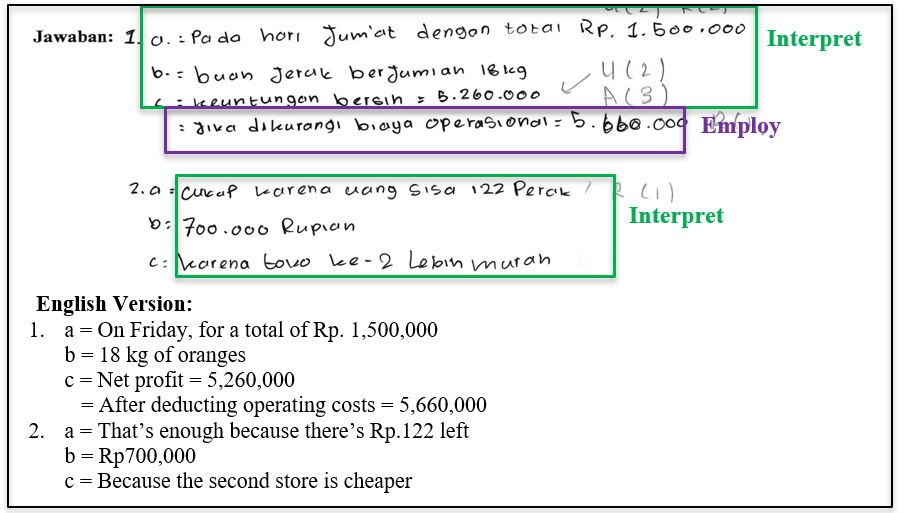
The numeracy skills of students in Indonesia are expected to be at a level that supports contextual problem-solving and higher-order thinking. However, international assessment results indicate that the numeracy skills of Indonesian students remain in the low category and have not yet met expected standards, as reflected in the 2022 PISA results, in which Indonesia achieved an average score of 366 points in mathematics well below the OECD average of 472 points. This study aims to analyze the numeracy ability of junior high school (SMP) students based on three cognitive domain indicators: Understanding (U), Applying (A), and Reasoning (R). A descriptive quantitative approach was employed with 32 students selected through purposive sampling. Data were collected through a written test consisting of 6 items with a maximum score of 72 points, supplemented by semi-structured interviews. Results indicate that the average numeracy score was 30.34%, classified as Low. No student reached the High or Very High category; 56.25% of students were in the Low category. Per-indicator analysis revealed a consistent decline from Understanding (38.80%), Applying (27.21%), to Reasoning (25.00%). Item 1a had the highest achievement rate (93.75%), while item 2c could not be answered by any student (0.00%). These findings indicate the urgent need for authentic context-based learning that fosters higher-order thinking skills at the junior high school level.
Downloads
References
Creswell, J. W., & Creswell, J. D. (2018). Research design: qualitative, quantitative, and mixed methods approaches (5th ed). SAGE Publications.
Fauziah, N., & Roza, Y. (2022). Kemampuan matematis pemecahan masalah siswa dalam penyelesaian soal tipe numerasi AKM. Jurnal Cendekia : Jurnal Pendidikan Matematika, 06(03), 3241–3250. https://doi.org/https://doi.org/10.31004/cendekia.v6i3.1471.
Hidayah, I. R., Kusmayadi, T. A., & Fitriana, L. (2021). Minimum competency assessment (AKM): an effort to photograph numeracy. JournaL of Mathematics and Mathematics Education, 11(1), 14–20. https://doi.org/10.20961/jmme.v11i1.52742.
Kusumaningtyas, A. (2020). Analisis soal pada buku matematika kelas VIII semester 1 ditinjau dari aspek kognitif TIMSS Skripsi, Universitas Muhammadiyah Surakarta.
Miftah, R. N., & Setyaningsih, R. (2022). Pengembangan LKPD Berbasis Asesmen Kompetensi Minimum (AKM) Pada Materi Geometri Untuk Meningkatkan Kemampuan Literasi Numerasi. AKSIOMA: Jurnal Program Studi Pendidikan Matematika, 11(3), 2199–2208. https://doi.org/https://doi.org/10.24127/ajpm.v11i3.5780.
Mullis, I. V. S., & Martin, M. O. (Eds.). (2017). TIMSS 2019 Assessment Frameworks. Chestnut Hill, MA: Boston College, TIMSS & PIRLS International Study Center.
Mullis, I. V. S., Martin, M. O., Foy, P., Kelly, D. L., & Fishbein, B. (2020). TIMSS 2019 International Results in Mathematics and Science. Boston College: TIMSS & PIRLS International Study Center.
Nuryami, N. (2024). Numeracy literacy of junior high school students in implementing the Merdeka mathematics learning curriculum. Alifmatika: Jurnal Pendidikan Dan Pembelajaran Matematika, 6(1), 63–77. https://doi.org/10.35316/alifmatika.2024.v6i1.63-77.
Nusantara, D. S., Zulkardi, & Putri, R. I. I. (2021). Designing Pisa-Like Mathematics Task Using A Covid-19 Context ( PISACOMAT ). Journal on Mathematics Education, 12(2), 349–364. https://doi.org/http://doi.org/10.22342/jme.12.2.13181.349-364.
OECD. (2019). PISA 2018 Results (Volume I): What Students Know and Can Do: Vol. I. OECD P. https://doi.org/10.1787/5f07c754-en.
OECD. (2023). PISA 2022 Results (Volume I): The State of Learning and Equity in Education: Vol. I. OECD Publishing. https://doi.org/10.1787/53f23881-en.
Rakhmawati, Y., & Mustadi, A. (2022). The circumstances of literacy numeracy skill : Between notion and fact from elementary school students. Jurnal Prima Edukasia, 10(1), 9–18. https://doi.org/https://doi.org/10.21831/jpe.v10i1.36427.
Setianingsih, W. L., & Ekayanti, A. (2022). Analisis kemampuan numerasi siswa SMP dalam menyelesaikan soal tipe asesmen kompetensi minimum (AKM). AKSIOMA: Jurnal Program Studi Pendidikan Matematika, 11(4), 3262–3273. https://doi.org/https://doi.org/10.24127/ajpm.v11i4.5915.
Stacey, K., & Turner, R. (Eds.). (2015). Assessing Mathematical Literacy: The PISA Experience. Cham: Springer International Publishing.
Sugiyono. (2019). Metode Penelitian Kuantitatif, Kualitatif, dan R&D (Edisi ke-2). Bandung: Alfabeta.
Umbara, U., & Suryado, D. (2019). Re-Interpretation of Mathematical Literacy Based on the Teacher ’ s Perspective. International Journal of Instruction, 12(4), 789–806. https://doi.org/https://doi.org/10.29333/iji.2019.12450a.
Wati, R. K., & Nurcahyo, A. (2023). Kemampuan Numerasi Siswa dalam Menyelesaikan Soal Geometri pada Asesmen Kompetensi Minimum. Jurnal Cendekia: Jurnal Pendidikan Matematika, 07(June), 1689–1699. https://doi.org/https://doi.org/10.31004/cendekia.v7i2.2380.
Wijaya, A., Heuvel-Panhuizen, M. van den, Doorman, M., & Robitzsch, A. (2014). Difficulties in solving context-based PISA mathematics tasks : An analysis of students ’ errors. The Mathematics Enthusiast, 11(3). https://doi.org/https://doi.org/10.54870/1551-3440.1317.
Downloads
Published
How to Cite
Issue
Section
Citation Check
License
Copyright (c) 2026 Hanipa, Duano Sapta Nusantara, Fiki Alghadari, Da Tien Nguyen

This work is licensed under a Creative Commons Attribution-ShareAlike 4.0 International License.
Authors who publish with this journal agree to the following terms:
- Authors retain copyright and grant the journal right of first publication with the work simultaneously licensed under a Creative Commons Attribution License that allows others to share the work with an acknowledgment of the work's authorship and initial publication in this journal.
- Authors are able to enter into separate, additional contractual arrangements for the non-exclusive distribution of the journal's published version of the work (e.g., post it to an institutional repository or publish it in a book), with an acknowledgment of its initial publication in this journal.
- Authors are permitted and encouraged to post their work online (e.g., in institutional repositories or on their website) prior to and during the submission process, as it can lead to productive exchanges, as well as earlier and greater citation of published work (See The Effect of Open Access).