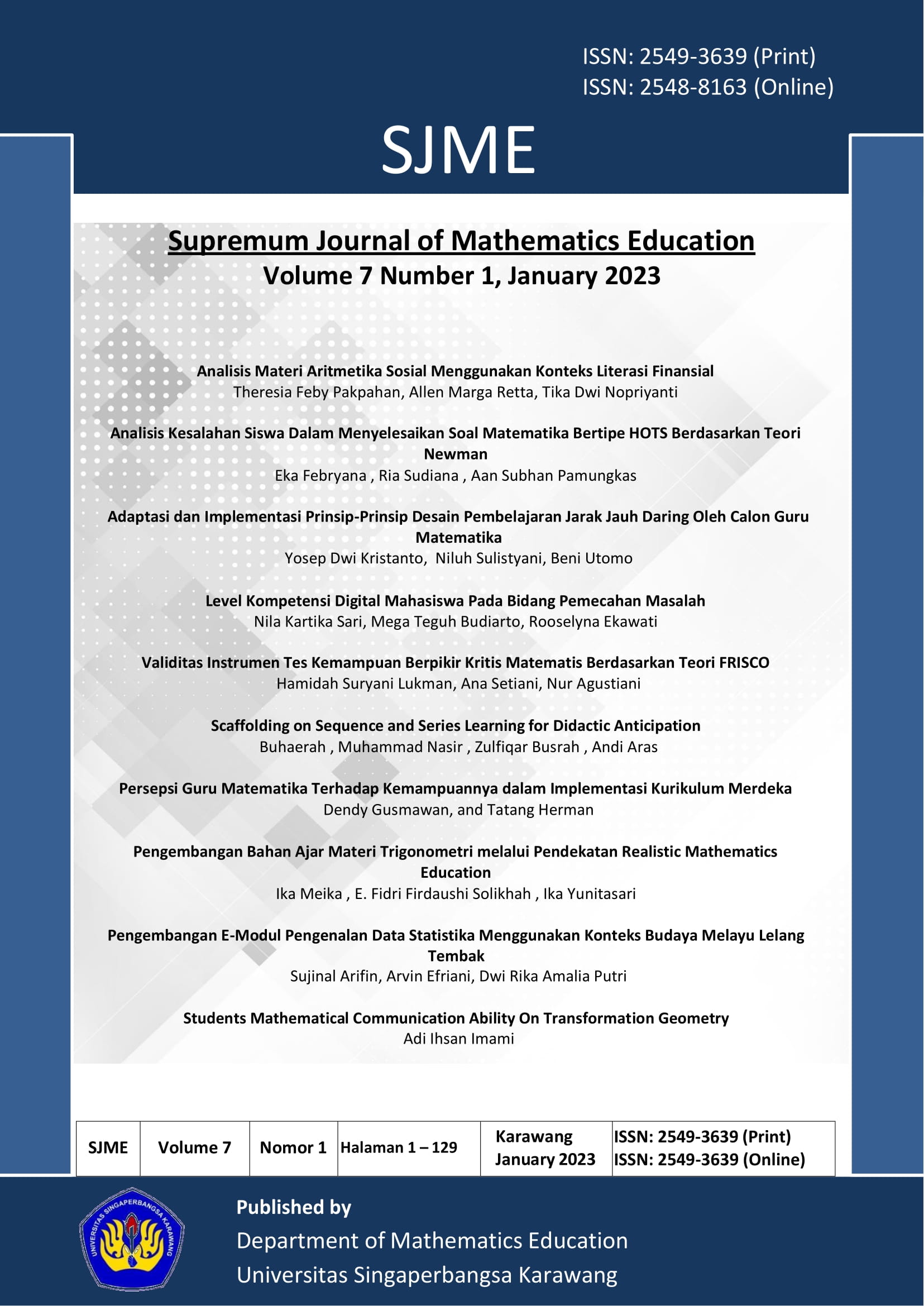
Level Kompetensi Digital Mahasiswa Pada Bidang Pemecahan Masalah
DOI:
https://doi.org/10.35706/sjme.v7i1.6629Abstrak
Penelitian ini bertujuan untuk mengidentifikasi level kompetensi digital mahasiswa Universitas Tribhuwana Tunggadewi pada bidang pemecahan masalah. Subjek penelitian adalah delapan mahasiswa pendidikan matematika pada semester tiga dan lima. Data level kompetensi digital subjek diperoleh dari hasil pengerjaan tes pemecahan masalah matematika, pengamatan saat pengerjaan, serta wawancara subjek. Hasil penelitian menunjukkan bahwa level kompetensi digital mahasiswa pendidikan matematika rata-rata adalah pada level 3 – 6, dan belum ditemukan mahasiswa pendidikan matematika yang berada pada level 1, 2, 7, atau pun 8.
Unduhan
Referensi
Astuti, D., Sukirwan, S., Pamungkas, A. S., & Yandari, I. A. V. (2022). Penggunaan Classroomscreen dan Google Jamboard untuk Meningkatkan Kemampuan Pemahaman Konsep Matematis Peserta Didik di Sekolah Dasar. SJME (Supremum Journal of Mathematics Education), 6(2), 139–149. https://doi.org/10.35706/sjme.v6i2.6407
Beswick, K., & Fraser, S. (2019). Developing mathematics teachers’ 21st century competence for teaching in STEM contexts. ZDM - Mathematics Education, 51(6), 955–965. https://doi.org/10.1007/s11858-019-01084-2
Bock, C. G., & Dimmel, J. K. (2020). Digital Representations without Physical Analogues : a Study of Body-Based Interactions with an Apparently Unbounded Spatial Diagram.
Bourn, D. (2018). From 21st Century Skills to Global Skills. 63–85. https://doi.org/10.1007/978-3-319-97655-6
Carreira, S., Jones, K., Amado, N., Jacinto, H., & Nobre, S. (2016). Youngsters Solving Mathematical Problems with Technology (Vol. 5). Springer International Publishing. https://doi.org/10.1007/978-3-319-24910-0
Carretero, S., Vuorikari, R., & Punie, Y. (n.d.). The Digital Competence Framework for Citizens With eight.
Carretero, S., Vuorikari, R., & Punie, Y. (2017). The Digital Competence Framework for Citizens. Luxembourg: Publications Office of the European Union. https://doi.org/10.2760/38842
Deursen, A. J. A. M. Van, Helsper, E. J., Eynon, R., Deursen, A. J. A. M. Van, Helsper, E. J., & Eynon, R. (2015). Development and validation of the Internet Skills Scale ( ISS ) Development and validation of the Internet Skills Scale ( ISS ). 4462(December). https://doi.org/10.1080/1369118X.2015.1078834
Dilling, F., & Witzke, I. (2020). The Use of 3D-Printing Technology in Calculus Education : Concept Formation Processes of the Concept of Derivative with Printed Graphs of Functions. 320–339.
Dumford, A. D., & Miller, A. L. (2018). Online learning in higher education: exploring advantages and disadvantages for engagement. Journal of Computing in Higher Education, 30(3), 452–465. https://doi.org/10.1007/s12528-018-9179-z
Engelbrecht, J., Borba, M. C., Llinares, S., & Kaiser, G. (2020). Will 2020 be remembered as the year in which education was changed ? ZDM, 52(5), 821–824. https://doi.org/10.1007/s11858-020-01185-3
Engelbrecht, J., Llinares, S., & Borba, M. C. (2020). Transformation of the mathematics classroom with the internet. ZDM - Mathematics Education, 52(5), 825–841. https://doi.org/10.1007/s11858-020-01176-4
Gleasman, C., & Kim, C. (2020). Pre-Service Teacher’s Use of Block-Based Programming and Computational Thinking to Teach Elementary Mathematics. Digital Experiences in Mathematics Education, 6(1), 52–90. https://doi.org/10.1007/s40751-019-00056-1
Ilomäki, L., Kantosalo, A., & Lakkala, M. (2011). What is digital competence ? 2 . Digital competence is an evolving concept. 1–11.
Jandrić, P. (2020). Postdigital Research in the Time of Covid-19. Postdigital Science and Education, 2(2), 233–238. https://doi.org/10.1007/s42438-020-00113-8
Joubert, J., Callaghan, R., & Engelbrecht, J. (2020). Lesson study in a blended approach to support isolated teachers in teaching with technology. ZDM - Mathematics Education, 52(5), 907–925. https://doi.org/10.1007/s11858-020-01161-x
Lam, O., & Zhihao, N. (2020). Examining primary students ’ mathematical problem ‑ solving in a programming context : towards computationally enhanced mathematics education. ZDM, 0123456789. https://doi.org/10.1007/s11858-020-01200-7
Mamolo, L. A. (2019). Analysis of Senior High School Students ’ Competency in General Mathematics. August. https://doi.org/10.13189/ujer.2019.070913
meinel, christoph, & leifer, larry. (2019). Design Thinking Research (C. Meinel & L. Leifer (eds.)). Springer International Publishing. https://doi.org/10.1007/978-3-319-97082-0
Ojeda, P. A., Morales, L. G., & Albalat, J. Q. (2019). Digital competences: Reality of students starting university life. Digital Education Review, 36.
Padmavathy, R. D., & Mareesh, K. (2013). Effectiveness of Problem Based Learning In Mathematics. International Multidisciplinary E-Journal, II(I), 45–51. www.shreeprakashan.com
Rozhana, K. M., & Sari, N. K. (2019). Karakter Untuk Menghadapi Era Sustainable Development of Learning Assessment on Character. Jurnal Pendidikan Dasar Nusantara, 4, 119–126.
Sari, N. K. (2021). Pemecahan Masalah Abad ke-21. Laduni Alfatama.
Sari, N. K., Budiarto, M. T., & Rozhana, K. M. (2021). Students’ Digital Thinking Skills in Solving Mathematics Problems. Proceedings of the 1st International Conference on Mathematics and Mathematics Education (ICMMEd 2020), 550. https://doi.org/10.2991/assehr.k.210508.076
Siswono, T. Y. E. (2010). Leveling Student’s Creativity in Solving and Posing Matehematical Problem. IndoMS. J.M.E, 1(1), 17–40.
Sokolov, S. S., Saveleva, M. N., & Mitrofanova, A. V. (2019). Implementation of educational programs with digital distance education technologies complying with the requirements for ship crew members. Open Education, 23(4). https://doi.org/10.21686/1818-4243-2019-4-44-53
Stacey, K., & Turner, R. (2015). Assessing mathematical literacy: The PISA experience. Assessing Mathematical Literacy: The PISA Experience, 1–321. https://doi.org/10.1007/978-3-319-10121-7
Sugandi, A. I., Bernard, M., & Linda, L. (2022). Meningkatkan Kemampuan Bepikir Kreatif melalui Penerapan Pendekatan Saintifik Berbantuan VBA Excel. SJME (Supremum Journal of Mathematics Education), 6(2), 111–121. https://doi.org/10.35706/sjme.v6i2.5795
Teräs, M., Suoranta, J., Teräs, H., & Curcher, M. (2020a). Post-Covid-19 Education and Education Technology ‘ Solutionism ’ : a Seller ’ s Market. 863–878.
Teräs, M., Suoranta, J., Teräs, H., & Curcher, M. (2020b). Post-Covid-19 Education and Education Technology ‘Solutionism’: a Seller’s Market. Postdigital Science and Education, 2(3), 863–878. https://doi.org/10.1007/s42438-020-00164-x
Trujillo-Torres, J. M., Hossein-Mohand, H., Gómez-García, M., Hossein-Mohand, H., & Cáceres-Reche, M. P. (2020). Mathematics teachers’ perceptions of the introduction of ict: The relationship between motivation and use in the teaching function. Mathematics, 8(12). https://doi.org/10.3390/math8122158
UNESCO. (2020). Education: From disruption to recovery. Unesco.Org. https://en.unesco.org/covid19/educationresponse
Van Laar, E., Deursen, A. J. A. M. Van, Dijk, J. A. G. M. Van, & Haan, J. De. (2020). Poetics Measuring the levels of 21st-century digital skills among professionals working within the creative industries : A performance-based approach. Poetics, 81(January), 101434. https://doi.org/10.1016/j.poetic.2020.101434
van Laar, E., van Deursen, A. J. A. M., van Dijk, J. A. G. M., & de Haan, J. (2020). Determinants of 21st-Century Skills and 21st-Century Digital Skills for Workers: A Systematic Literature Review. In SAGE Open (Vol. 10, Issue 1). https://doi.org/10.1177/2158244019900176
Van Laar, E., Van Deursen, A. J. A. M., Van Dijk, J. A. G. M., & De Haan, J. (2017). The relation between 21st-century skills and digital skills: A systematic literature review. Computers in Human Behavior, 72, 577–588. https://doi.org/10.1016/j.chb.2017.03.010
Vuorikari, R., Punie, Y., Carretero, S., & Van Den Brande, L. (2016). DigComp 2.0: The Digital Competence Framework for Citizens. In Jrc-Ipts (Issue June). https://doi.org/10.2791/11517
Unduhan
Diterbitkan
Cara Mengutip
Terbitan
Bagian
Citation Check
Lisensi
Hak Cipta (c) 2023 Nila Kartika Sari, Mega Teguh Budiarto, Rooselyna Ekawati

Artikel ini berlisensiCreative Commons Attribution-ShareAlike 4.0 International License.
Hak cipta dilindingi undang-undang berdasarkan Undang-undang Nomor 28 Tahun 2014 tentang Hak Cipta. Dilarang memperbanyak isi jurnal ini, baik sebagian maupun seluruhnya dalam bentuk apapun tanpa izin tertulis dari SJME (Supremum Journal of Mathematics Education) sebagai pemegang Hak Cipta terhadap seluruh isi dari jurnal tersebut.
Penulis yang menerbitkan jurnal ini setuju dengan persyaratan berikut:
- Penulis mempertahankan hak cipta dan memberikan hak jurnal tentang publikasi pertama dengan karya yang secara bersamaan dilisensikan di bawah Lisensi Atribusi Creative Commons yang memungkinkan orang lain membagikan karya tersebut dengan pengakuan dari karya penulis dan publikasi awal dalam jurnal ini.
- Penulis dapat memasukkan pengaturan kontrak tambahan yang terpisah untuk distribusi non-eksklusif dari versi terbitan jurnal tersebut (misalnya, kirimkan ke repositori institusional atau publikasikan dalam sebuah buku), dengan sebuah pengakuan atas publikasi awalnya di Jurnal ini.
- Penulis diizinkan dan didorong untuk memposting pekerjaan mereka secara online (misalnya di repositori institusional atau di situs web mereka) sebelum dan selama proses penyampaian, karena dapat menyebabkan pertukaran yang produktif, serta kutipan karya yang diterbitkan sebelumnya dan yang lebih lama.