Investigating Metacognitive Awareness and Mathematical Resilience in Linear Programming Problem Solving among University Students: An Exploratory Factor Analysis (EFA)
DOI:
https://doi.org/10.35706/sjme.v10i2.13420Keywords:
Metakognisi, Resiliensi matematis, CFA, Explanatory sequential design, Program linier.Abstract
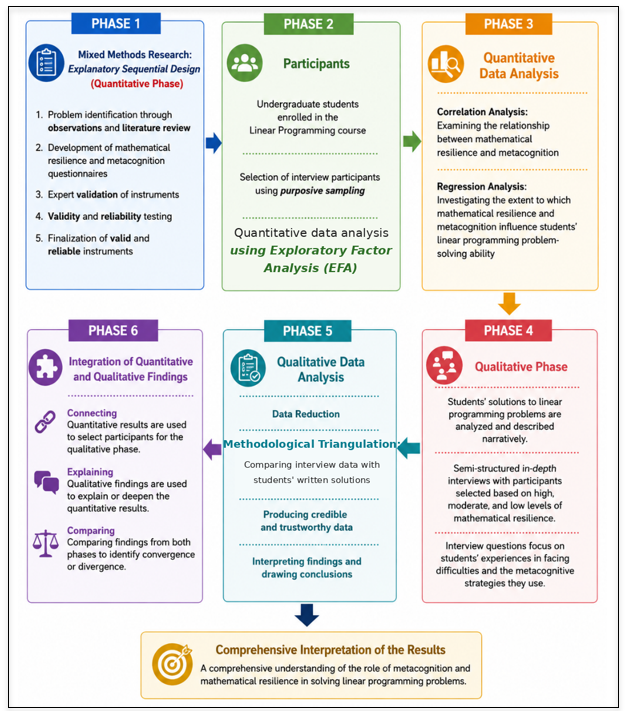
Metacognition and mathematical resilience are two key contributing factors in enhancing students’ ability to solve problems. However, limited research has explored how these two factors interact and influence one another. This study aims to investigate the relationship between students’ mathematical resilience and metacognition in solving linear programming problems. The research employs a mixed-method approach with an explanatory sequential design. The findings, based on validity and reliability testing, indicate that the questionnaire instrument used has good measurement quality, with Cronbach’s alpha values exceeding 0.60 for each construct—0.84 for metacognition and 0.70 for mathematical resilience. The results also reveal that both metacognition and mathematical resilience are multidimensional constructs that complement each other. Students with strong metacognitive awareness are better able to plan, monitor, and evaluate their problem-solving strategies. At the same time, they demonstrate high perseverance, are less likely to give up, and are able to recover when facing difficulties, particularly in solving linear programming problems. This study produces a validated questionnaire instrument that can serve as a reference for future research in developing effective instructional approaches to enhance students’ abilities in applied mathematics.
Downloads
References
Akben, N., 2020. Effects of the problem-posing approach on students’ problem solving skills and metacognitive awareness in science education. Res Sci Educ 50, 1143–1165.
Akkan, S.N., Horzum, T., 2024. Illuminating the Landscape of Mathematical Resilience: A Systematic Review. Journal of Pedagogical Research 8, 312–338.
Arjun, M., Muntazhimah, M., 2023. The Effect Of Mathematical Resilience On The Mathematical Problem-Solving Ability Of Students. AKSIOMA: Jurnal Program Studi Pendidikan Matematika 12, 944–950.
Baiduri, Y.M.C., Ulfah, F., 2022. The Intuitive Thinking Process of High Ability Students in Mathematical Problem Solving Based on Gender. Journal of Hunan University Natural Sciences 49.
Barep Yohanes, Y., 2022. Resiliensi matematis calon guru matematika dalam pembelajaran berbasis masalah. Jurnal Kajian Pembelajaran Matematika 6, 96–107.
Fatimah, A.E., Purba, A., Siregar, Y.A., 2020. Hubungan resiliensi matematis terhadap kemampuan pemecahan masalah matematis mahasiswa pada mata kuliah Matematika dasar. Journal of Didactic Mathematics 1, 151–157.
Güner, P., Erbay, H.N., 2021. Metacognitive Skills and Problem-Solving. International Journal of Research in Education and Science 7, 715–734.
Herdiansyah, G.P., Kholid, M.N., Ariyanti, I., Ulfah, F., Djamilah, S., 2024. Defragmenting reflective thinking in solving contextual arithmetic series in terms of gender, in: AIP Conference Proceedings. AIP Publishing.
Herman, T., Fatimah, S., 2023. Considering the Mathematical Resilience in Analyzing Students’ ProblemSolving Ability through Learning Model Experimentation. International Journal of Instruction 16, 219–240.
Hutauruk, A.J.B., Darmayasa, J.B., Priatna, N., 2019. Achievement of students mathematical resilience through problem based learning model with metacognitive approach. J Phys Conf Ser 1315, 012051. https://doi.org/10.1088/1742-6596/1315/1/012051
Kartika, D.L., 2020a. Aktivitas Metakognisi Mahasiswa dalam Pemecahan Masalah Program Linear (Studi Kasus Berdasarkan Perbedaan Gender). Square : Journal of Mathematics and Mathematics Education 2, 119. https://doi.org/10.21580/square.2020.2.2.6481
Kartika, D.L., 2020b. Aktivitas metakognisi mahasiswa dalam pemecahan masalah program linear (studi kasus berdasarkan perbedaan gender). Square: Journal of Mathematics and Mathematics Education 2, 119–131.
Komalasari, N., Nuraida, I., 2024. Studi Resiliensi Matematis dan Implikasinya terhadap Hasil Belajar Statistika Penelitian pada Mahasiswa Pendidikan Matematika, in: Gunung Djati Conference Series. pp. 61–72.
Lee, C., Johnston-Wilder, S., 2017. The construct of mathematical resilience, in: Understanding Emotions in Mathematical Thinking and Learning. Elsevier, pp. 269–291.
Lee, N.H., Ng, K.E.D., Yeo, J.B.W., 2019. Metacognition in the teaching and learning of mathematics. Mathematics education in Singapore 241–268.
Mashuri, A., 2021. Analisis Kesulitan Mahasiswa dalam Menyelesaikan Masalah Konseptual Program Linier. Laplace: Jurnal Pendidikan Matematika 4, 1–11.
NIHAYAH, E.F.K., 2020. Peran efikasi diri tinggi dalam membentuk kemampuan berpikir kreatif matematika mahasiswa pada perkuliahan program linear. Jurnal Pendidikan Glasser 4, 127–142.
Prifti, V., Dervishi, I., Dhoska, K., Markja, I., Pramono, A., 2020. Minimization of transport costs in an industrial company through linear programming, in: IOP Conference Series: Materials Science and Engineering. IOP Publishing, p. 012040.
Santoso, S. 2012. Analisis SPSS pada statistik parametrik. Jakarta: PT. Elex Media Komputindo.
Sari, I.P., Purwasih, R., Nurjaman, A., 2017. Analisis Hambatan Belajar Mahasiswa Pada Mata Kuliah Program Linear. JIPM (Jurnal Ilmiah Pendidikan Matematika) 6, 39. https://doi.org/10.25273/jipm.v6i1.1569
Sugiyono. 2016. Metode penelitian kuantitatif kualitatif dan R&D. Bandung: Alfabeta.
Suliani, M., Juniati, D., Lukito, A., 2024. Mathematics belief impact on metacognition in solving geometry: Middle school students. Journal of Education and Learning (EduLearn) 18, 286–295.
Suliani, M., Juniati, D., Lukito, A., 2023. Students’ metacognitive processes to solve arithmetic sequence problems in terms of mathematical ability, in: AIP Conference Proceedings. AIP Publishing.
Ulfah, F., 2022. Spatial Thinking Skills of Prospective Teacher Students Based on Gender in Mathematics Problems. Okober.
Utami, W.B., Dewi, A.P., Widodo, S.A., 2024. Students’errors In Problem-Solving Reviewed From The Perspective Of Math Resilience. Johme: Journal Of Holistic Mathematics Education 8, 59–74.
Downloads
Published
How to Cite
Issue
Section
Citation Check
License
Copyright (c) 2026 Fithria Ulfah, Mega Suliani, Normi Abdul Hadi, Mayada

This work is licensed under a Creative Commons Attribution-ShareAlike 4.0 International License.
Authors who publish with this journal agree to the following terms:
- Authors retain copyright and grant the journal right of first publication with the work simultaneously licensed under a Creative Commons Attribution License that allows others to share the work with an acknowledgment of the work's authorship and initial publication in this journal.
- Authors are able to enter into separate, additional contractual arrangements for the non-exclusive distribution of the journal's published version of the work (e.g., post it to an institutional repository or publish it in a book), with an acknowledgment of its initial publication in this journal.
- Authors are permitted and encouraged to post their work online (e.g., in institutional repositories or on their website) prior to and during the submission process, as it can lead to productive exchanges, as well as earlier and greater citation of published work (See The Effect of Open Access).